USA
USA UK
UK Egypt
Egypt South Africa
 UAE
UAE Pakistan
 Hungary
 Kenya
Kenya Zimbabwe
 Belgium
How to Choose a Children’s Sports Business Opportunity: 7 Things to Look For
Considering a kids sports franchise, children’s activity business or tennis coaching business? Here are
the key factors to examine before investing – and how the Teddy Tennis Business Partner model works.
Starting a children’s sports business can be an attractive way to combine entrepreneurship with sport, education and children’s development. But not every opportunity is structured in the same way, and the cheapest option is not necessarily the best fit.
If you are comparing a kids sports franchise, a low-investment children’s franchise, a children’s education business or a tennis coaching opportunity, it is worth looking beyond the headline licence fee. The quality of the programme, training, territory, business systems, marketing support, scalability and customer experience can all affect what you are really buying.
Teddy Tennis has spent more than two decades developing a structured early-years programme that combines tennis with music, pictures, characters, stories, movement and imaginative play. Today, Teddy Tennis is expanding in selected US markets through local Business Partners.

What Is a Kids Sports Franchise or Business Opportunity?
A children’s sports franchise or licensed business opportunity gives an entrepreneur access to an established brand, programme, curriculum, training system and operating framework rather than requiring them to create everything from scratch.
Depending on the model, support may include lesson plans, branding, coach training, equipment guidance, marketing resources, booking technology and ongoing operational assistance. Prospective owners should understand exactly what is included, what remains their responsibility and how the business can grow locally.
Teddy Tennis is designed for children aged approximately 2-6, with age-appropriate progression across four
developmental groups. The programme combines sport and early-years learning through a multi-sensory approach in which children see, hear and physically participate.
7 Factors to Consider When Choosing a Children’s Sports Business
1. Look for a Proven Programme and Business Model
Before investing, investigate the history of the programme, the quality of its curriculum, its target audience, how
customers are acquired and the support system behind it. An established programme can save years of curriculum development, testing and brand-building.
2. Understand the Total Investment
Do not focus only on the initial franchise or licence fee. Consider training, equipment, insurance, venue costs,
marketing, staff and coaches, technology, working capital, payment-processing costs and ongoing royalties. Ask for current financial and legal information before making a decision.
3. Check the Training and Support
Training matters particularly if you are new to children’s sports or early-years delivery. Ask whether the business
provides structured coach training, lesson plans, marketing assets, operational guidance, brand resources, technology and ongoing support after launch.
4. Consider Your Own Role
You do not necessarily need to be a professional tennis player to own a children’s sports business. A more important question is whether you want to coach personally, manage coaches, develop school and venue partnerships, or build a larger operation. The answer affects the kind of opportunity that will suit you.
5. Research Your Territory
Study the number of families with young children, preschools, daycare centers, schools, tennis clubs, sports facilities and community venues in your area. Look at local competitors and potential partnership opportunities. A clearly defined territory can also matter when you are investing time and money in building a local brand.
6. Think About Scalability
Do not only ask, “Can I start this business?” Ask, “Can I grow it?” Look for the ability to add coaches, venues,
classes, schools, camps and other activities. A scalable model may allow an owner to progress from personally
delivering classes to managing a larger local operation.
7. Evaluate the Brand and Customer Experience
In children’s activities, parents buy the programme but children experience it. A strong concept therefore has to work for both. Teddy Tennis uses music, games, stories, pictures, teddy bear characters and imaginative play to make early tennis engaging and memorable for young children.
What Does a Children’s Sports Business Look Like in Practice?
Teddy Tennis New Orleans provides one example of how a local operation can develop. It launched in 2023, initiallyworking with a small number of schools and building the business progressively.

The operation now delivers Teddy Tennis through multiple school and club venues with a trained coaching team. As the business has developed, its owners have increasingly been able to focus on leadership, partnerships and quality rather than personally delivering every class.
Important: These are historical results from one independently operated Teddy Tennis business and are not a guarantee of future performance. Results will vary by territory, operator, pricing, demand, costs and execution. The figures combine revenue recorded through CONNECT with direct-payment revenue calculated from royalty declarations made to Teddy Tennis Ltd.
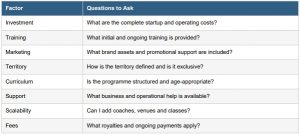
Affordable Franchise Opportunities: What Should You Compare?
When searching for an affordable franchise opportunity or a low-investment children’s franchise, compare value
rather than simply price.
Why Consider a Children’s Education Business?
Many parents are looking for activities that do more than simply occupy children. A children’s education business can combine physical activity with listening, coordination, confidence, social interaction and learning.
Teddy Tennis uses a Visual, Auditory and Kinesthetic approach for its US audience: children learn by seeing, hearing and doing. Its programme is designed around young children’s development rather than simply adapting adult tennis instruction for smaller players.
How to Start a Tennis Coaching Business
If you want to start a tennis coaching business, you can build your own programme or work with an established
brand. Building independently gives you control, but you will need to create your own curriculum, brand, lesson plans, coach-training system, marketing strategy, business processes and customer-acquisition approach.
Working with an established programme can provide a ready-made framework. Teddy Tennis Business Partners
receive access to the programme and brand, curriculum and teaching resources, training, marketing support,
CONNECT booking technology and ongoing support.
How the Teddy Tennis USA Business Partner Model Works
Teddy Tennis is currently expanding into selected US territories. Business Partners typically build their local operation through existing preschools, daycare centers, schools, sports clubs and community venues, so dedicated premises are not normally required.
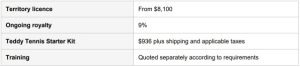
Territory size and final commercial terms are agreed with each prospective Business Partner. Prospects should review the full agreement and take their own legal and financial advice before entering into a business relationship.
Can It Work as a Family Business?
A children’s sports business can suit partners or family members with complementary skills. One person might focus on local business development and relationships, another on administration and marketing, while trained coaches deliver classes. The important point is to establish clear responsibilities and operate the business professionally.
Frequently Asked Questions
What should I look for in the best kids sports franchise?
There is no single best option for everyone. Compare the programme, total investment, territory, training, support, customer proposition, operating model and growth potential against your own goals and local market.
Is Teddy Tennis suitable for young children?
Yes. Teddy Tennis is designed for children approximately 2-6 years old and uses age-appropriate activities, music,
movement, pictures, stories and characters.
Do I need to be a tennis coach?
Not necessarily. Business ownership and coaching are different roles. A Business Partner may coach personally or
recruit and manage appropriately trained coaches, depending on the operation.
How much does it cost to start a Teddy Tennis business?
Current US territory licences start from $8,100, with a 9% ongoing royalty. The Teddy Tennis Starter Kit is $936 plus shipping and applicable taxes, and training is quoted separately. Final terms depend on the agreed territory and requirements.
Do I need my own tennis facility?
Not normally. Teddy Tennis can be delivered through suitable preschools, daycare centers, schools, clubs, sports
facilities and community venues.
Can I grow beyond one location?
The model is designed to allow Business Partners to add coaches, venues and classes within their agreed territory, subject to the terms of their agreement.
Could Teddy Tennis Work in Your Community?
Teddy Tennis is looking for prospective Business Partners in selected US markets. The opportunity may appeal to
entrepreneurs, tennis and sports professionals, PE teachers, children’s activity operators and parents who believe they could build a strong local business around an established early-years programme.
You do not necessarily need to be an experienced tennis coach. We are interested in people who can build
relationships, develop a local market and uphold the quality of the Teddy Tennis programme.